who's walking who?

an ethnographic study of emotional labor in care work

Role

User Researcher

Timeline

4 Weeks | Sep 2025 - Oct 2025

Team

Partner - Amelie Or
THE setup

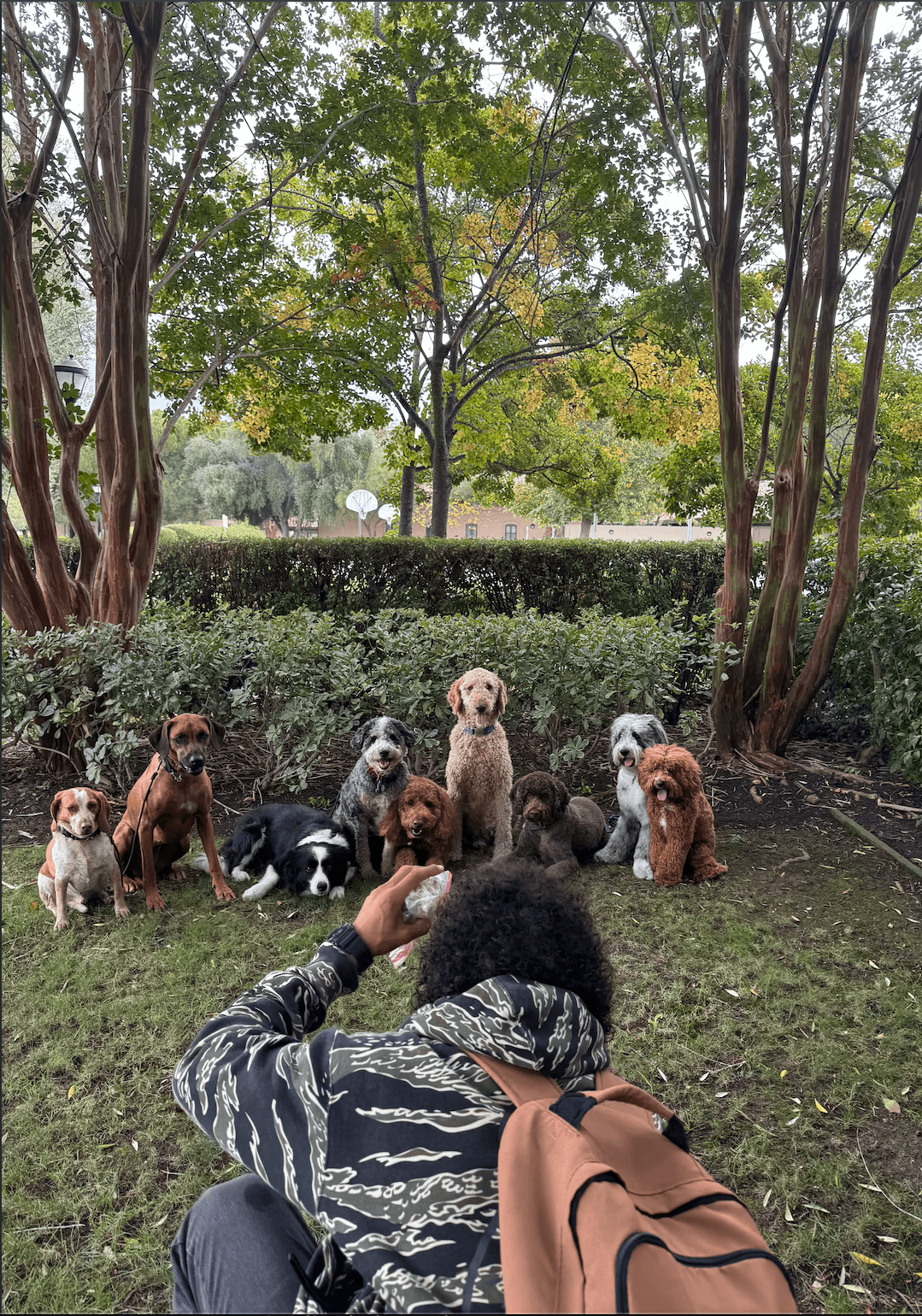
We spent 20+ hours embedded in the world of Bay Area dog walkers.

I shadowed professional dog walkers, interviewed them, walked dogs alongside them. The goal: understand a community through participant observation, not just interviews. We wanted to better understand the needs of professional dog walkers by gaining a better understanding of their lives, not just their jobs.

20+

Hours of fieldwork

6

In-depth interviews

3

Major findings

Initial Assumptions: Being raised with dogs, I'd initially assumed that:


  • Professional dog walking was something one was drawn to due to love for dogs and a desire to spend time with them as a side hustle/gig work.

    • To me, the role was akin to Doordash driving or Shipt shopping, and the job itself was mostly owners bringing their dogs to one person who walked them then stayed at a designated spot until pickup was completed.


  • The hardest part of the job was keeping that many dogs in line.

    • When Amelie and I decided to study dog walkers further, we were fascinated by the mass. Was walking 8-10 dogs at once easier or harder than we thought?

USER RESEARCH

After 20+ hours of interviews, walks, and discussion, we utilized user research methods to make sense of our data.

We created 3 main findings from our analysis. To communicate an understanding of our walkers that was grounded in the hours we spent getting to know them, our findings needed to be clear, grounded in first-order observation, and novel, revealing something about them that we only could have learned through the time we spent.

Then, using the Five Whys framework, we directed our findings and data into actionable insights and needs.
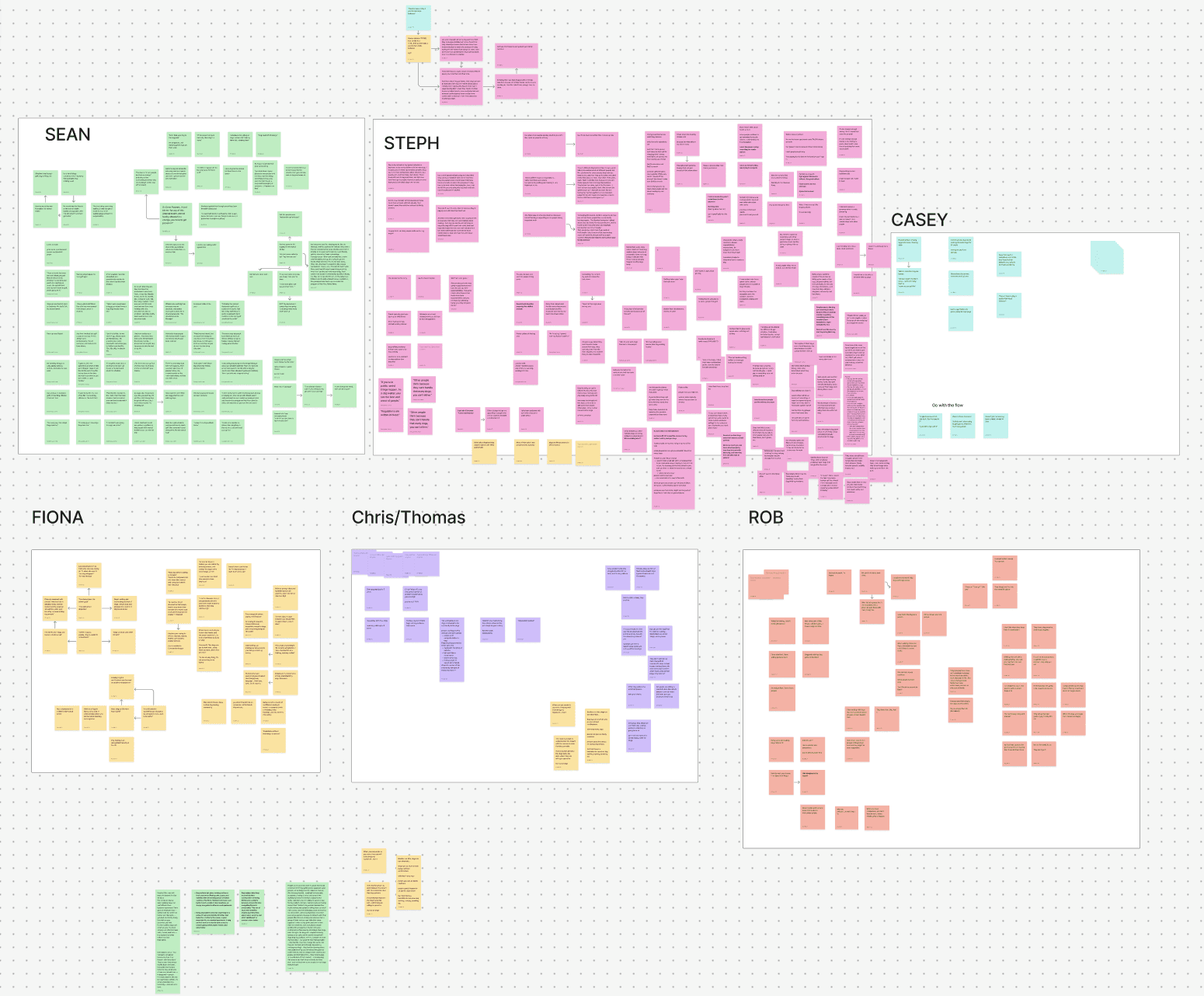
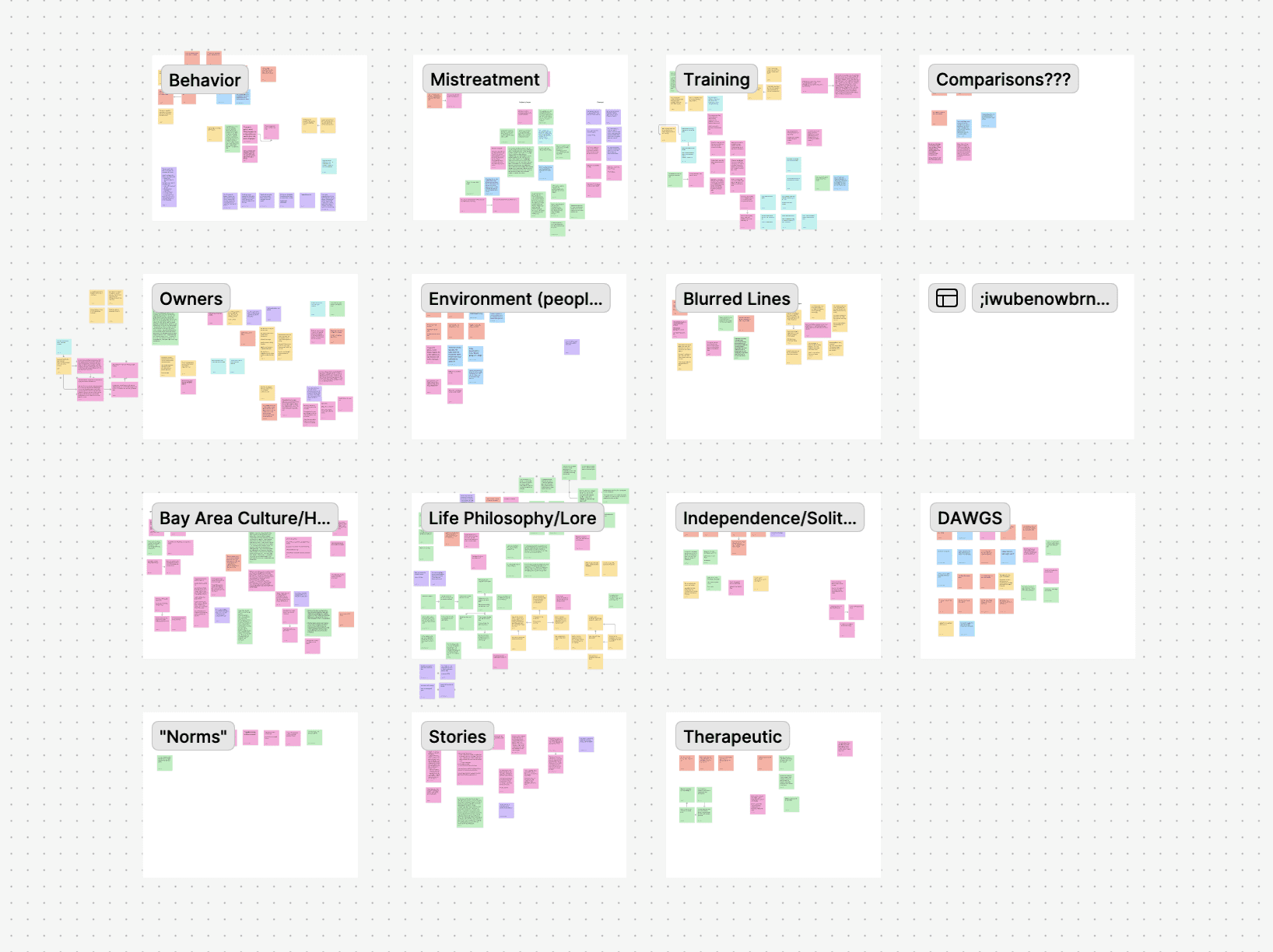
Beginning of data synthesis - quotes, observed behaviors, patterns across interviews, common themes/motifs, and more

FINDING 1

Many dog walkers don’t own dogs, and those who do describe caring for them as part of their work.

"I have to spend so much time with other people’s dogs, so when I get home. I don’t feel like doing anything with my dogs."

— Steph Haddad, owner of Good Sit: Dog Training and Group Play Services

An easy assumption to make about people who walk dogs for a living is that they have dogs at home; we were surprised to learn that this is rarely the case. Using the 5 Whys in response to our finding, we got to the bottom of one potential explanation:

UNPACKING COMPASSION FATIGUE

WHY 1

Dog walkers spend so much time caring for other people’s pets that they feel they don't have the capacity to care for their own.

WHY 2

The process of regularly keeping tabs on how a dog and their owner feel mentally, physically, and emotionally makes them susceptible to burnout and compassion fatigue.

WHY 3

Because every walk requires emotional regulation (reading the dog’s mood, the owner’s expectations, the energy of the street), their own emotions are constantly deprioritized.

WHY 4

Over time, suppressing their own emotions to manage others’ leads them to associate attachment with exhaustion, and care starts to feel like something that drains them rather than fulfilling them.

WHY 5

To protect that fragile sense of calm, they begin to reserve intimacy only for paid care, creating emotional boundaries in their personal lives that mirror their professional ones.

Overall, this first finding captured a very clear alignment between the high standard of care dog walkers feel dogs need to receive, the capacity for care they feel they’re able to provide after working, and the upset they express over people not providing care for their pets to the degree they believe is acceptable.

Key Insight:

Professional dog walkers experience care as emotionally labor-intensive work that consumes their capacity for attachment, causing them to ration care in their personal lives and redefine intimacy as something that must be tightly controlled.

FINDING 2

Dog walkers light up when describing the dogs that other people call “difficult.”

“The dogs you get to work with...seeing them succeed...that’s why you do it.”

— Fiona, owner of It's Not Magic Dog Training

When talking about their favorite experiences with dogs, walkers didn't talk about the calm, obedient ones. They talked about the anxious dogs, the reactive ones, the "bite risks." They described consistency as the key indicator; a dog with different reactions to the same stimulus is vulnerable, not dangerous. Understanding patterns and changing those reactions to confirm that dog learned to feel safe and secure was the reward.


During one walk, a dog bolted from Steph's car and ran out of a cul-de-sac, but she didn't run, yell, or panic. She walked calmly in the dog's direction and said: "When you run after them, they think it's a game. When you yell, who wants to come back to someone yelling?"

UNPACKING FAVORED DIFFICULTY

WHY 1

Dog walkers measure success in progress, so when a reactive or fearful dog begins to change, that progress is tangible proof of their care and skill.

WHY 2

Anxious, scared, or frustrated dogs show their emotions openly, so their reactions make growth visible in a way that calm, obedient dogs don’t.

WHY 3

The honesty of emotive reaction resonates with dog walkers who have also felt misjudged or overlooked; they relate to dogs who are struggling to be understood.

WHY 4

Dog walkers often see life as something that happens to them rather than for them: unstable housing, health issues, unfair employers, or failed systems. In caring for dogs who’ve also been neglected, reactive, or misunderstood, they reclaim the compassion they once needed themselves.

WHY 5

By caring for “broken” or “troubled” dogs, walkers practice the kind of patience, safety, and steadiness they wish the world had offered them. Each walk becomes a quiet rehearsal for healing, both the dog’s and their own.

This attraction is deeply personal. Many dog walkers have experienced instability, mistreatment, or being misjudged themselves. They identify with dogs labeled “difficult” not as problems, but as victims of circumstance who need structure rather than punishment. By meeting these dogs where they are, walkers practice a form of compassion they once lackedm, reclaiming agency in a world that has often felt unfair or uncontrollable.

Key Insight:

Dog walkers find meaning, identity, and self-worth through guiding visible transformation in others, especially those who are misunderstood, because it affirms both their skill and their own capacity for healing.

FINDING 3

Dog walkers proudly define themselves as the people who make it possible to “hustle” in a hustle culture.

"[People] focus more on the outside, like working, but we don’t see whats most important in life, like being around family…but I also understand you have to take care of your family."

— Roberto Smith, walker at Ry The Pet Guy, @robs_dogs_

This final finding presented the most interesting insight into one of the strongest tensions among the interviews: the angst they felt for the hustle culture of the Bay Area and the pride they took in being able to help those whom they deemed were busy or unable to care for their dogs.

They expressed how unhealthy it was for people to succumb to the individualism perpetuated by a fast-paced lifestyle and the ripple effect it has on the dogs, yet they stated with pride that they were the ones helping busy people.

UNPACKING HUSTLE TENSION

WHY 1

Dog walkers see their work as giving owners the freedom to rest, focus, or work longer hours; they keep the dog’s needs met so the owner’s life can keep moving.

WHY 2

Dog walkers and owners both treat dogs as “family,” but they also share an unspoken agreement that love can be outsourced if care is consistent.

WHY 3

By providing that consistency, dog walkers begin to see themselves less as service workers and more as co-parents, invisible partners maintaining the family’s emotional stability.

WHY 4

That sense of quiet partnership gives them dignity and purpose: they keep others’ lives humane in a culture that forgets how to slow down.

WHY 5

The same culture that exhausts them depends on their calm; their labor sustains the very speed they’re trying to escape.

Dog walkers find pride in knowing their work keeps other people’s lives humane. They slow dogs down, create routines, and become the caretakers of values that hustle culture tends to erode.


Yet this identity is deeply conflicted. Dog walkers are people who critique hustle culture while sustaining it, supplying the emotional slack that allows it to persist. Their calm becomes a resource others consume, even as they themselves remain overworked, underpaid, and exhausted. In choosing this work for their mental health and sense of meaning, they embody a tension at the heart of modern care labor: providing their care to hold together a system that doesn't care for them.

Key Insight:

Dog walkers are people who find dignity and identity in being the invisible support system that makes hustle culture livable, absorbing its emotional costs so others can keep moving, even as it quietly exhausts them.

the insight

Dog walkers are deeply empathetic individuals who have often been overlooked, mistreated, or burned by unstable systems; they use dog walking as a way to bring the care, stability, and compassion into the world that they feel is missing.

Dog walking as gig work might serve as the entry point, but eventually, their lives become centered around the dogs they walk and the owners they service. They exist within a cycle of being the stable force of care for others and not having enough energy to reciprocate that care in their personal lives due to the lines between their personal and professional lives constantly being blurred.
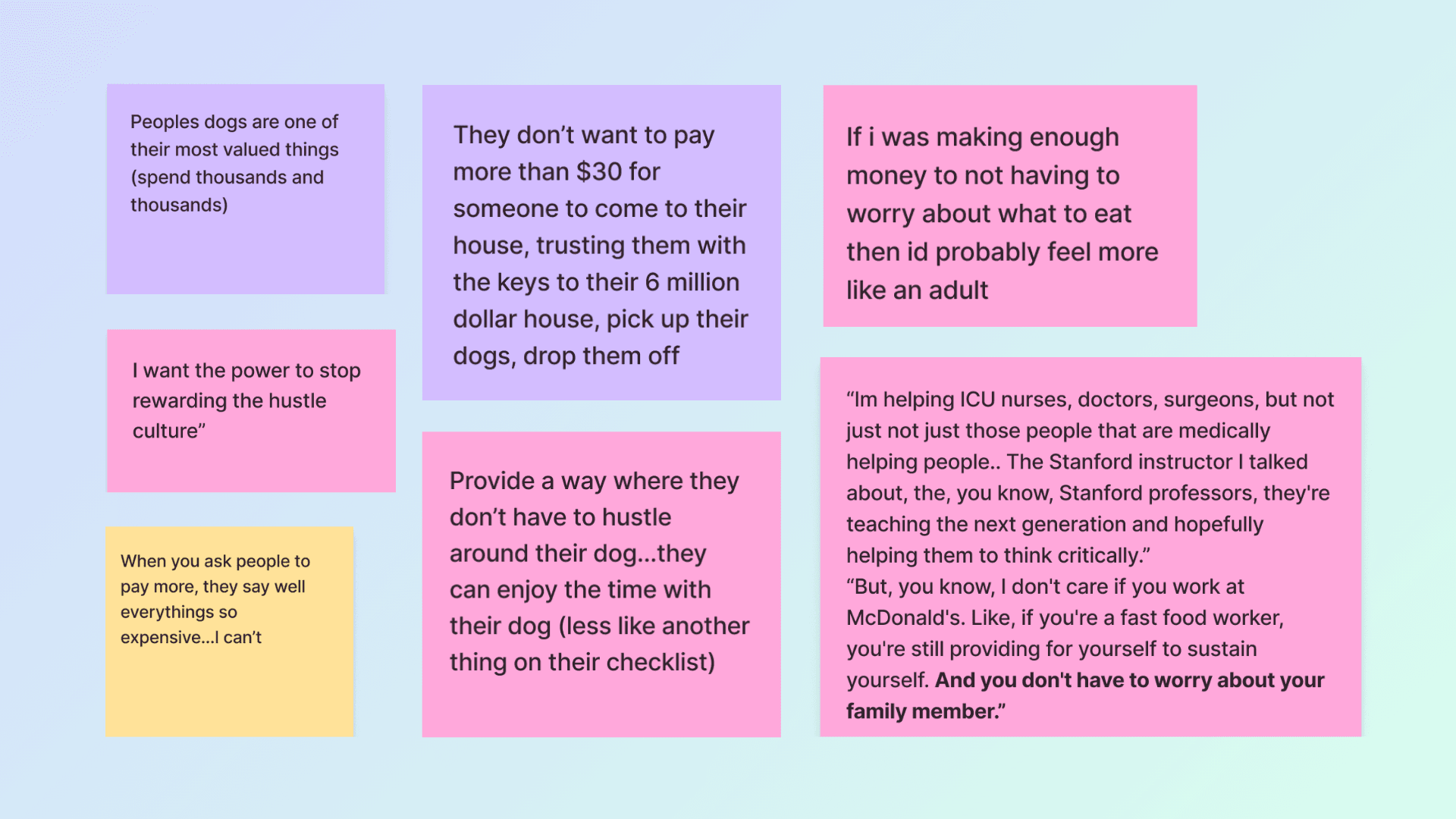
More quotes relating to hustle culture & struggle

research methods

Ethnographic observation + semi-structured interviews

20+ hours of participant observation (shadowing, walking dogs alongside professionals)

6 in-depth semi-structured interviews with professional dog walkers

5 Whys methodology to uncover root causes of behavioral patterns

Thematic analysis using empathy mapping and affinity diagramming

Field notes and voice recordings (with consent) for synthesis

Why ethnography matters: Interviews alone wouldn't have revealed these patterns. I needed to see how walkers interacted with dogs, how they talked about their work when they thought nobody was analyzing them, how their body language shifted from question to question. I needed to see where their mindset was on the job, and it was important for me to stand in their shoes with them as I did.

reflections

Research isn't just about finding answers; it's about finding and travelling down unanticipated rabbit holes.

Walking interviews took anywhere from 1 to 5 hours, so our strongest observations didn't come from questions we made; they came from the questions that came from answers we heard and the curiosities that sparked as we did the job with the walkers.

From completing pickups and dropoffs to changing note-taking strategies on walks that moved over 4 miles per hour, our best work came from grounding ourselves in the environment and asking questions that arose from the gap between what we assumed and what we now saw being in the dog walking space.

Ultimately, this project served as a reminder that there is no understanding the needs of any group until you attempt to live their lives, not just in a professional sense, but in a personal one as well. User research functions as the glue between product innovation and real-world impact; I was thrilled by the opportunity to scratch the surface of how much there was to uncover, no matter how attuned to the group you believe your assumptions might be.

Additional info

Want to connect?

The walkers we spoke to are amazing people with businesses that are bringing joy to dogs all over the Bay Area. Please click on the links below to reach out for any services you or your pup might need!

Thank you so much to Amelie O for your amazing partnership on this project, and thank you to Will O for your guidance throughout the process!

ready to collaborate? let's chat

ready to collaborate? let's chat

ready to collaborate? let's chat

ready to collaborate? let's chat